Little Lab Portable Microscopy for Field-Based Homeschooling
 Jordan HaleStaff Writer
November 16, 2026. This exploration details how high-resolution portable optics integrate into modern home education curricula. It is written for parents and educators seeking to bridge the gap between indoor theory and outdoor discovery.
I remember standing on the edge of a damp creek bed, the smell of wet cedar heavy in the air, watching a group of students struggle to keep a traditional glass slide level. The sun was dipping low, and the frustration was palpable; the tools they had were designed for a sterile laboratory bench, not the uneven reality of the Pacific Northwest. The first thing I noticed was how the heavy, cast-iron base of a standard microscope felt like an anchor rather than an asset when you are three miles from the nearest paved road. Science in a home-learning environment often suffers from this friction—the transition from the kitchen table to the backyard frequently results in broken glass or lost focus. According to the National Science Teaching Association, hands-on inquiry is the bedrock of long-term retention, yet the logistical hurdles of sensitive equipment often discourage spontaneous investigation. When the equipment is too precious to move, the world remains a series of static images in a textbook rather than a living, breathing ecosystem waiting to be magnified.
It turns out that the solution lies in decoupling the lens from the laboratory. Traditional homeschooling often relies on a beginner science microscope gift set to spark initial interest, but as the curriculum advances into ecology or botany, the need for mobility becomes paramount. I have spent weeks watching how students interact with their environment when they aren't tethered to an eyepiece. They move faster, they look deeper, and they ask questions that only arise when you can see the serrated edge of a leaf while it is still attached to the tree. This shift from 'collect and bring back' to 'examine in situ' changes the psychological approach to biology. Instead of a specimen being a dead thing on a slide, it remains a part of a system. This is especially vital when selecting a stem toys microscope for 8 year old learners, where the tactile experience of discovery is just as important as the optical magnification itself.
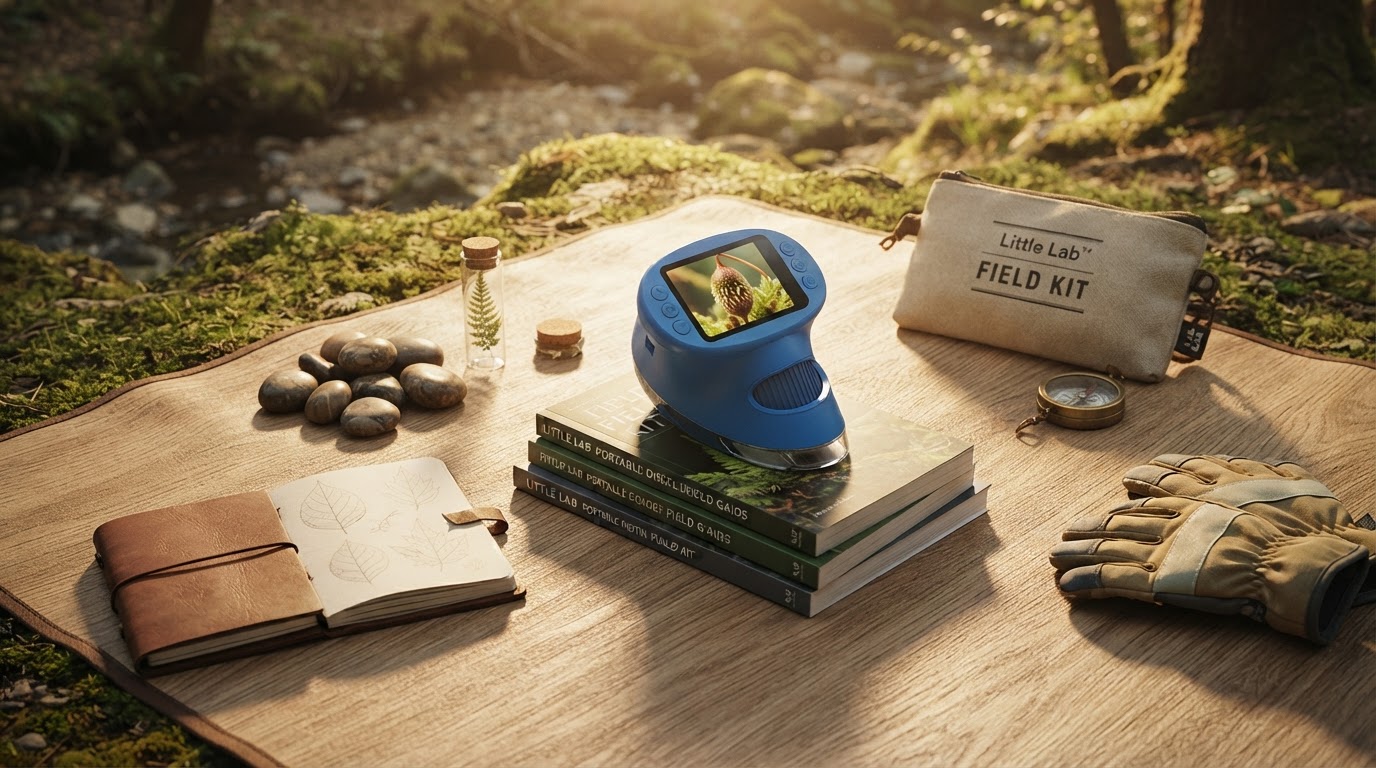
Somewhere around week two of using the Little Lab digital microscope, the workflow of our lessons shifted entirely. The device fits into a jacket pocket, yet provides a clarity that rivals the bulky units I used in university. Because it utilizes a digital interface, it circumvents the eye-strain common in younger children who haven't yet mastered the art of closing one eye to peer through a tube. I watched a student toggle the magnification on a patch of moss, the internal LED illuminating the hidden forests between the fibers with a crispness that felt almost cinematic. The portability doesn't just mean it's easy to carry; it means the microscope is present at the moment of curiosity. When a student finds a strange beetle or an iridescent pebble, they don't have to wait twenty minutes to get back to the house to see it. They see it now. This immediacy is what makes it a superior usb microscope for homeschooling, as the data can be captured instantly and analyzed later on a larger screen. The integration of high-quality sensors within a rugged, handheld frame allows the Little Lab to survive the inevitable drops and bumps that occur during a hike.
I keep coming back to the idea that the best tool is the one that actually gets used. A high-end laboratory station gathering dust on a shelf is worth far less than a portable device that is covered in a little bit of trail dirt. When evaluating a device for your home curriculum, consider these specific criteria to ensure the tool supports rather than hinders the learning process:
- Optical clarity that maintains sharp edges at the highest magnification levels without digital blurring.
- Battery life that exceeds the duration of a standard field trip, typically four hours or more of active use.
- On-board storage or seamless connectivity for saving images to a digital science journal.
- Integrated lighting that can be adjusted to prevent washout on reflective surfaces like wet rocks or wings.
- A form factor that allows for one-handed operation while the other hand holds a specimen or a notebook.