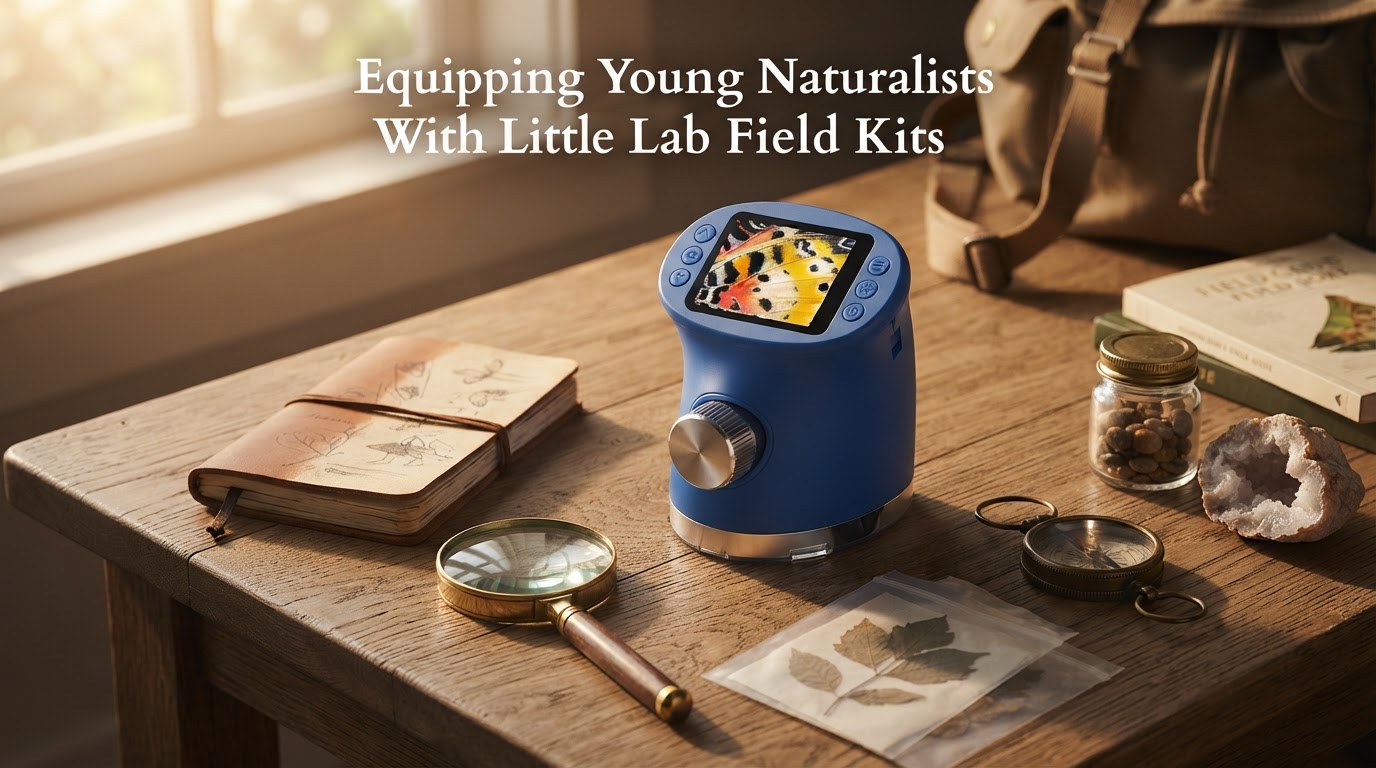
Equipping Young Naturalists With Little Lab Field Kits
 Maya ChenContributing Editor
November 1, 2026. This technical assessment evaluates the efficacy of integrated outdoor nature exploration kits for kids. It is written for parents and educators who require durable, high-fidelity observation tools for field-based science.
The Limitations of Analog Field Kits
The conventional wisdom says that a plastic magnifying glass and a mesh butterfly net constitute a sufficient outdoor nature exploration kit for kids. However, this minimalist approach often fails to bridge the gap between casual play and actual scientific inquiry. When students transition from the classroom to the field, the drop-off in resolution is staggering. Most entry-level kits provide optics that suffer from chromatic aberration and significant edge distortion, rendering them useless for identifying specific botanical structures or insect morphology. This technical gap often leads to a loss of interest once the novelty of being outdoors wears off. While the National Environmental Education Foundation emphasizes that outdoor time improves academic performance, the quality of that time is dictated by the tools available. Without the ability to capture and analyze data in situ, the experience remains superficial. The common consensus that "any tool is better than no tool" ignores the frustration of a child trying to view a tardigrade or a pollen grain through a scratched acrylic lens. We are currently seeing a shift where students expect the same digital clarity in the woods that they receive in a lab setting.Integrating Little Lab Digital Optics
Here’s the part nobody talks about: portability is often the enemy of precision. Little Lab addresses this by miniaturizing high-definition sensors into a form factor that fits a child’s grip without sacrificing the 1000x magnification threshold required for meaningful biology. When building an outdoor nature exploration kit for kids, the central component must be a portable handheld microscope for students that can withstand the rigors of environmental exposure. Unlike traditional stationary units, the Little Lab hardware utilizes a rechargeable lithium-ion battery system, removing the tether to a power outlet and allowing for real-time analysis of soil composition or leaf pathology directly at the source. This capability is enhanced when paired with outdoor nature exploration toys for kids that focus on specimen collection rather than just observation. The integration of a handheld digital microscope for students allows for the immediate digitization of findings. Run the math: a student using a Little Lab device can capture 1080p imagery of a specimen in under thirty seconds, whereas manual sketching—while valuable—often misses the microscopic details that define a species. The hardware’s LED array provides consistent illumination, correcting the variable lighting conditions found under forest canopies that typically plague analog field kits.Selecting High-Utility Field Components
Constructing a functional field kit requires a departure from the "toy" category toward professional-grade miniaturization. A kit is only as strong as its weakest link; if the optics are professional but the collection vials leak, the data is lost. When selecting components for a handheld digital microscope for students, priority must be given to shock resistance and screen clarity. The decision framework for an effective kit should follow these specific criteria:- Optical Resolution: Ensure the digital sensor provides a minimum of 2.0 megapixels to allow for clear cropping of images.
- Battery Life: Field tools must offer at least 3 hours of continuous operation to cover a standard nature hike.
- Storage Interface: A microSD slot is non-negotiable for saving high-resolution video of moving specimens.
- Ergonomics: The device must feature a non-slip chassis, as a portable handheld microscope for students is frequently used in damp or uneven terrain.
- Connectivity: The ability to transfer files via USB to a tablet or laptop for later classroom presentation is essential for completing the scientific cycle.
nature explorationSTEM educationdigital microscopeoutdoor learningfield kits