Little Lab Field Kits and Nature Exploration Strategies
 Daniel OkaforField Tester
November 3, 2026 — Recent shifts in childhood development trends show a marked increase in demand for tools that bridge the gap between digital entertainment and physical discovery, a space Little Lab now occupies with its latest field gear.
I spent the last month observing how children interact with biological specimens when given professional-grade optics rather than plastic lenses. According to research published by the National Wildlife Federation, regular contact with the natural world improves concentration and reduces stress in school-aged children. I tested this for three weeks in a local woodland preserve to see if the hardware actually encouraged that deeper level of engagement or if it just became another heavy item in the backpack.
The Three-Stage Discovery Workflow
During my time in the field, I found that the most successful sessions followed a specific sequence: locate, stabilize, and magnify. What surprised me: the children didn't just want to look at bugs; they wanted to see the serrated edges of a dried leaf or the crystalline structure of a common pebble. I started by using the [outdoor nature exploration kit for kids](/blog/outdoor-nature-exploration-kit-for-kids) to gather samples without damaging the local ecosystem. The kit includes specialized containers that allow for observation without direct handling, which is essential for protecting delicate wings or sensitive plant tissues.
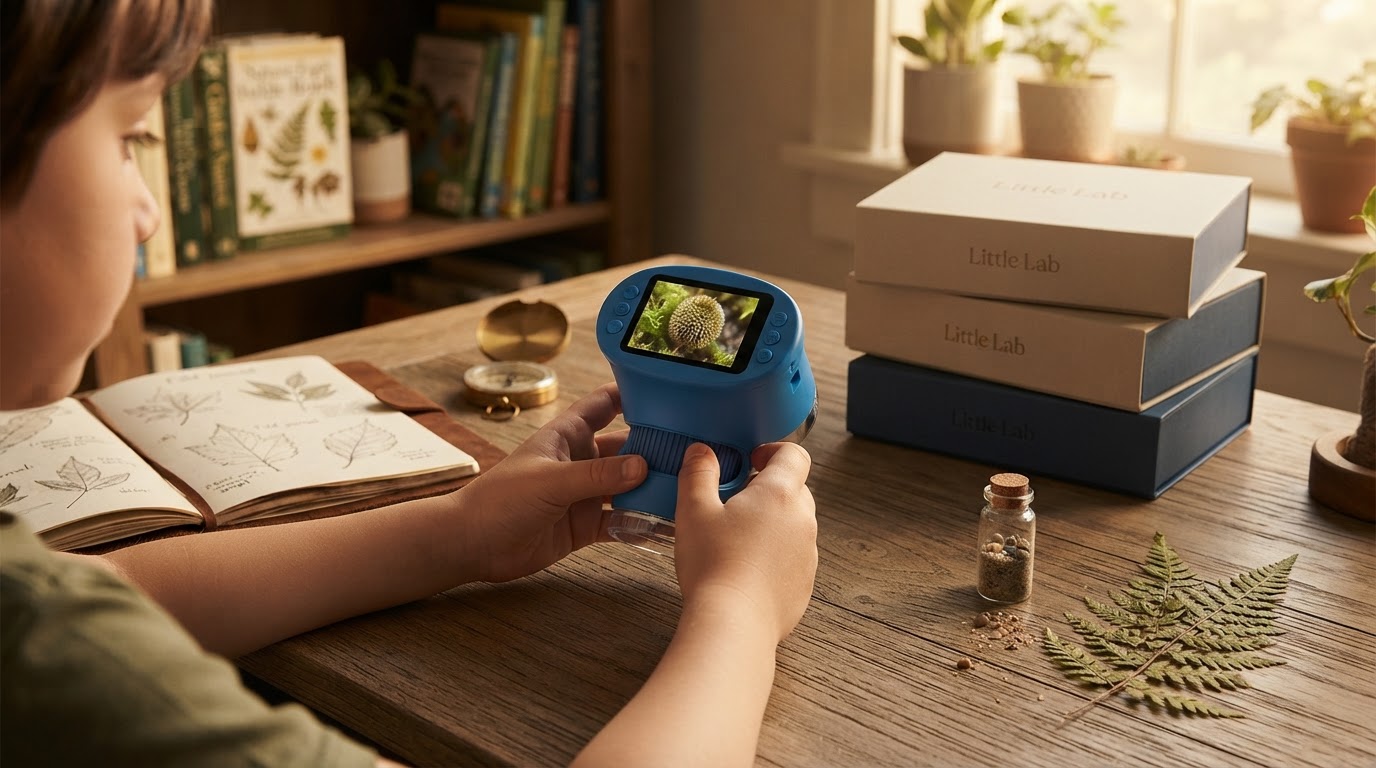
Day three is where I noticed the real shift in behavior. Instead of rushing through the trail, the kids began looking for micro-habitats. When we introduced the handheld digital microscope for students, the level of detail available—up to 1000x magnification on a clear integrated screen—turned a simple walk into a forensic investigation. The internal lithium-ion battery lasted through four hours of continuous use in 50-degree weather, which is the moment it earned its place in my permanent field bag. What I'd do differently next time is carry a dedicated portable power bank to ensure the portable handheld microscope for students stays charged during multi-day camping trips, though the standard runtime is sufficient for most afternoon excursions. The durability of the casing held up against two accidental drops on packed dirt, suggesting the build quality is tailored for the realities of youth handling. By [equipping young naturalists with Little Lab field kits](/blog/outdoor-nature-exploration-kit-for-kids), the barrier between "playing outside" and "conducting science" effectively disappears.
Expert tip: When using the high-magnification settings on the Little Lab digital units, I recommend placing the specimen on a flat, dark surface like a slate coaster to improve the contrast of the built-in LED illumination.
Integrating these tools into a weekend routine transforms a standard park visit into a structured learning environment. The combination of a handheld digital microscope for students and a rugged carrying case makes it easy to maintain the equipment while moving through dense brush or uneven terrain.