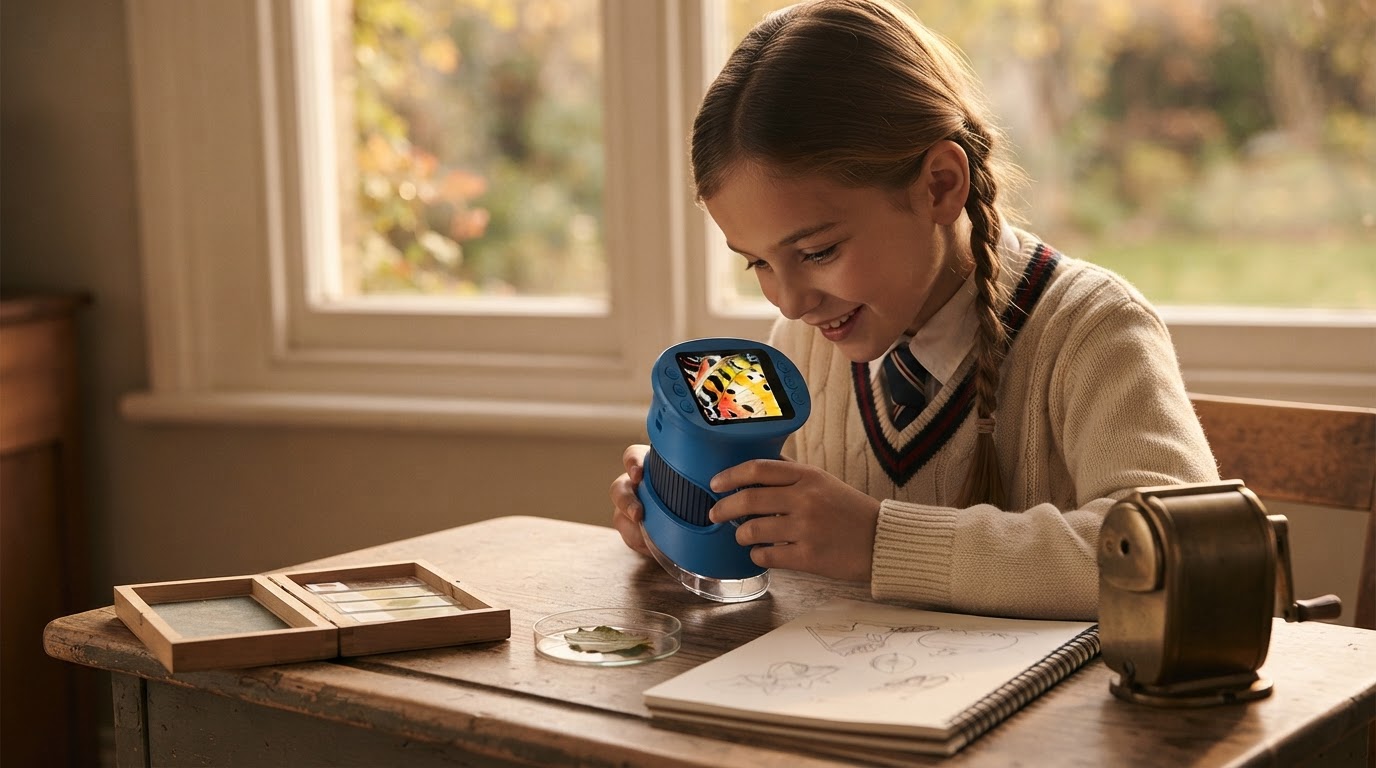
How do I use a Little Lab handheld microscope for school?
 Priya RamanSenior Analyst
November 5, 2026 — Using a Little Lab handheld microscope for student research requires a systematic approach to specimen preparation and digital capture to ensure data is viable for academic reporting.
Students and educators often seek tools that bridge the gap between traditional laboratory equipment and mobile field studies. The utility of these devices hinges on the user's ability to maintain stability and lighting consistency in non-traditional environments. Think of it as a matrix of portability, magnification power, and digital documentation capabilities that dictates the success of a student’s scientific inquiry.
How do students stabilize a Little Lab microscope in the field?
Stabilization is achieved by utilizing a three-point contact method or a dedicated stand to prevent motion blur during high-magnification observation. When students transition from a stationary desk to an outdoor environment, the lack of a mechanical stage introduces variables that can degrade image quality. According to standard optical physics, even sub-millimeter tremors are magnified proportionally to the zoom level, making a steady base essential for clear identification of cellular structures.
Two axes matter here: the physical orientation of the device and the surface tension of the specimen. For solid objects like minerals or textiles, students should rest the transparent shroud of the Little Lab unit directly against the object to establish a fixed focal plane. For biological samples that require backlighting, using a slide holder or a flat, neutral-colored surface helps maintain the necessary contrast for the digital sensor to process the image accurately. The decision rule: if the magnification exceeds 50x, the device must be braced against a stationary object to ensure the digital autofocus can lock onto the target without interference from hand tremors.
How is digital data captured for student lab reports?
Digital data is captured by syncing the Little Lab device to a tablet or computer via a USB or wireless interface, allowing for real-time measurement and annotation. This process transforms a simple observation into a quantifiable data point suitable for formal lab reports. Modern pedagogical standards emphasize the importance of visual evidence, and the ability to export high-resolution JPEG or MP4 files directly from the microscope software streamlines the documentation process for young naturalists.
Once you see it this way, the microscope functions less like a toy and more like a peripheral sensor for a larger data ecosystem. Students should follow a specific workflow: initial scan at low magnification to locate the area of interest, followed by a high-resolution capture once the focus is sharp. The software provided with Little Lab units typically includes basic measurement tools, enabling students to calculate the actual size of a specimen by calibrating the pixel count against a known scale. This quantitative step is what separates casual observation from rigorous academic work, providing the necessary metrics for comparative analysis in biology or materials science assignments.
Quick answers
Q: What is the maximum effective magnification for a Little Lab student unit? / A: Most Little Lab handheld models offer a functional range up to 1000x digital magnification, though optical clarity is most consistent between 50x and 200x for handheld use. This range is sufficient for identifying plant cells, small insects, and fabric fibers.
Q: Can the Little Lab microscope be used with a standard Chromebook? / A: Yes, Little Lab devices are designed to be plug-and-play with ChromeOS, Windows, and macOS, typically appearing as a standard UVC camera. This allows students to use the native camera app or specialized educational software to view the live feed.
Q: Does the device require an external light source for outdoor use? / A: The Little Lab handheld microscope features an integrated LED ring light with adjustable brightness, meaning it does not require external sunlight or lamps to illuminate a specimen. This internal lighting ensures consistent exposure even when working in shaded forest environments.
To further enhance student outcomes, consider integrating these tools into broader [Little Lab nature exploration strategies](/blog/little-lab-nature-exploration-strategies). When [equipping young naturalists with Little Lab field kits](/blog/outdoor-nature-exploration-kit-for-kids), it is vital to provide a structured environment for their observations. The handheld digital microscope for students serves as the primary bridge between the macroscopic and microscopic worlds.
Learn more about Little Lab at https://kidsdigitalmicroscope.com.