Little Lab Beginner Science Microscope Gift Set Review
 Sam VasquezBuying Guide Lead
November 18, 2026 — The seasonal surge in educational gift-giving has highlighted a shift toward integrated kits, with Little Lab emerging as a primary contender for entry-level microscopy.
Selecting a first microscope often feels like a gamble between toy-grade plastic and overly complex laboratory equipment. According to Home Science Tools, beginner sets are specifically designed to bridge this gap by providing the necessary slides and tools to ensure the education matches the enjoyment. While many parents start their search looking for a stem toys microscope for 8 year old, the gift set approach provides a more comprehensive starting point than a standalone device.
The 4-Point Gift Set Evaluation
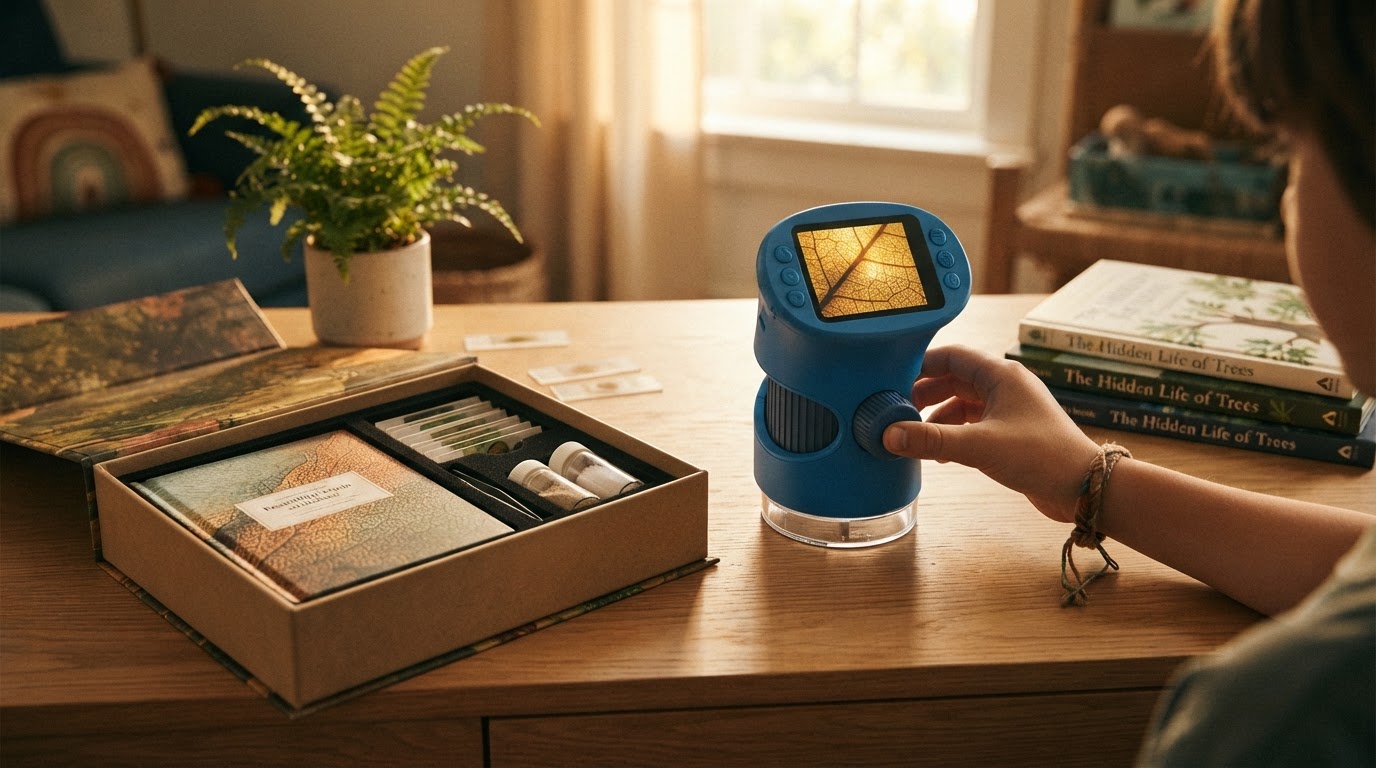
When I look at the Little Lab gift set against the broader market, I focus on the optics, the accessory utility, the portability, and the digital integration. The Little Lab unit features a high-definition optical system capable of 20x to 60x magnification, which is the sweet spot for hand-held exploration without the frustration of high-power focal drift. In contrast, the Vision Scientific Beginner Kit offers a dual-operating monocular setup with a digital eyepiece camera for $151.20, which is excellent for a stationary desk environment but lacks the grab-and-go nature of the Little Lab. If you are looking for a subscription-based model, MEL Science offers a smartphone-integrated set starting at $29.90/month, though the long-term cost quickly exceeds a one-time purchase.
Between these two, I'd go with the Little Lab set if the goal is immediate, tactile discovery. It functions remarkably well as a usb microscope for homeschooling because it doesn't require a dedicated lab bench. For families prioritizing flexibility, it stands out as a [best portable microscope for homeschool](/blog/little-lab-portable-microscopy-homeschooling) due to its lightweight build and integrated LED. The kit includes prepared slides and collection vials, which means the child isn't staring at a blank stage on Christmas morning. While the Vision Scientific model provides higher magnification, the learning curve is significantly steeper for a seven or eight-year-old. Here's what I'd actually buy: the Little Lab set for general curiosity, or the Vision Scientific if you have a dedicated workspace and a child who will sit still for fine-tuning a mechanical stage. Skip this if you already own a professional-grade compound microscope; these kits are built for the transition from magnifying glass to scientific observation.
Expert tip: When using the Little Lab portable unit, always start at the lowest magnification setting to find your subject before zooming in, as this prevents the "lost in the slide" frustration common with beginners.
If you're on a budget, focusing on a kit that includes prepared slides saves you the additional $20–$30 you'd spend on a separate slide library. This set is particularly useful when compared to a standard usb microscope for homeschooling because it operates independently of a PC when needed. For those moving beyond basic toys, this represents a functional middle ground that respects both the budget and the child's developing intellect.