Little Lab Digital Imaging for Early Science Education
 Priya RamanSenior Analyst
November 24, 2026. This analysis examines the integration of high-definition digital imaging into early childhood STEM development. It is designed for parents and educators seeking a structured framework for selecting optical tools that balance durability with technical precision.
When evaluating the landscape of early science tools, think of it as a matrix of optical magnification versus digital utility. Traditional optics often present a steep learning curve for children who lack the fine motor skills to calibrate manual stages or the ocular focus required for glass eyepieces. According to the National Association for the Education of Young Children (NAEYC), technology in the early childhood classroom should be used to support and extend learning rather than serve as a passive distraction. The primary friction point in home science is the transition from viewing a microscope toy for toddlers to using a tool capable of genuine discovery. Two axes matter here: the ease of image capture and the stability of the viewing platform. Without a stable digital output, a child's initial curiosity often turns to frustration as they struggle to align their eye with a narrow lens. By moving the image to a screen, the experience shifts from a solitary, difficult task to a shared social activity where a parent and child can observe the same specimen simultaneously. This collaborative observation is critical for language development and scientific inquiry, as it allows for immediate questioning and verification of what is being seen on the display.
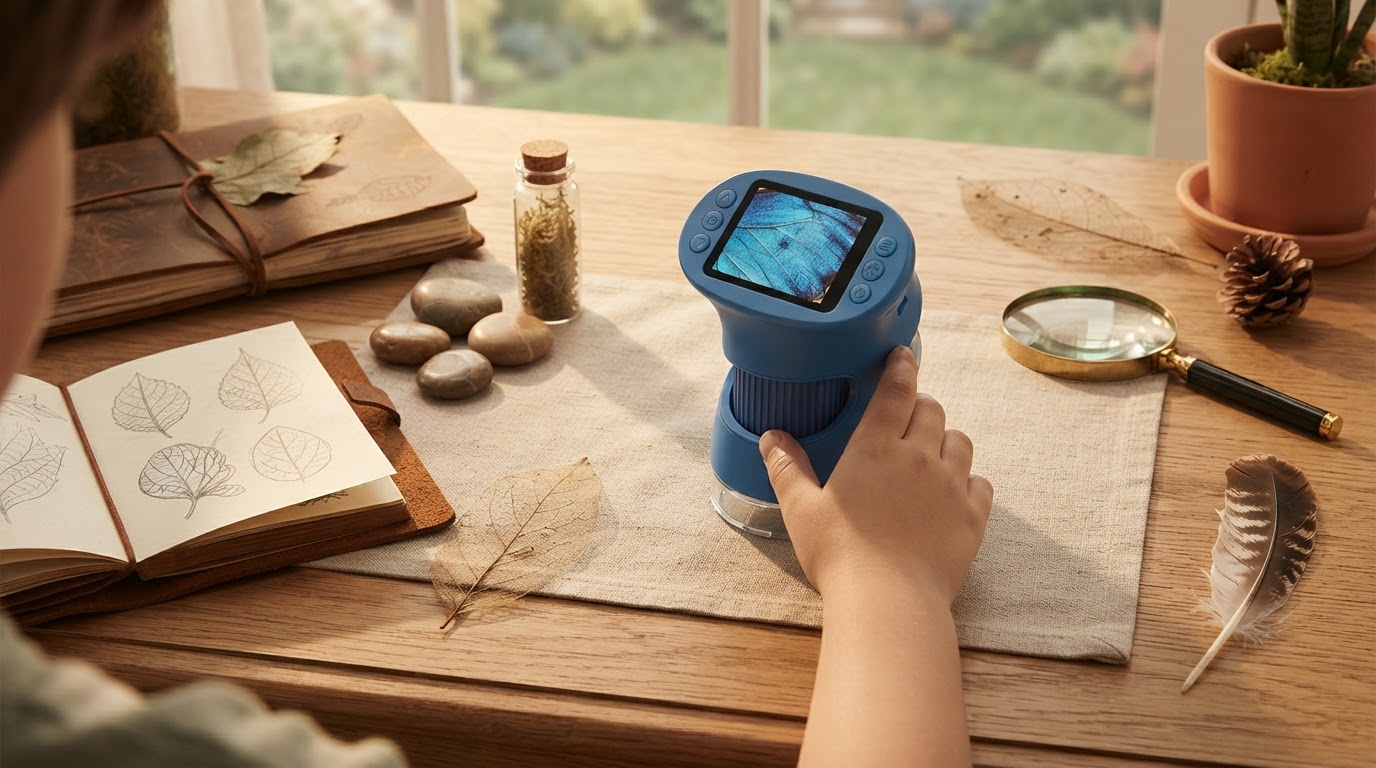
Little Lab addresses these developmental hurdles by prioritizing a high-resolution digital interface that removes the physical barrier of the eyepiece. Unlike a basic microscope toy for toddlers, the Little Lab system utilizes a CMOS sensor to project live feeds directly onto a built-in screen or connected device. This design philosophy centers on the ergonomics of a child's hand; the focus dials are oversized for tactile feedback, and the lighting is integrated to prevent the need for external lamp positioning. For parents moving beyond the best beginner microscope for 8 year old category, the Little Lab hardware offers a bridge between play and professional-grade observation. The device supports photo and video capture, allowing students to document their findings—a key component of the scientific method that is often missing in entry-level toys. The optics are shielded within a ruggedized housing to withstand the inevitable drops and bumps of a household environment. By providing a fixed focal path, the system ensures that even a best beginner microscope for 8 year old user can achieve a clear image without the complex slide preparation usually required for high-magnification biology. Once you see it this way, the value of the digital screen becomes clear: it is not just a convenience, but a tool for accessibility that allows children with varying degrees of visual acuity or motor control to participate fully in STEM activities.
Selecting the right instrument requires a specific decision rule: prioritize the screen refresh rate and sensor clarity over raw magnification numbers. High magnification is useless if the image is blurry or the frame rate lags, as children will lose interest if the movement of the specimen does not match what they see on the screen. When assessing a microscope toy for toddlers versus a digital lab, look for a system that allows for both portable field use and stationary desk observation. The following checklist serves as a decision framework for your investment:
- Digital Output: Ensure the screen resolution is sufficient to show cell structures or insect anatomy without pixelation.
- Power Source: Verify if the unit is rechargeable for outdoor exploration or requires a constant tether to a computer.
- Storage Capability: Look for SD card slots or internal memory to save images for later school projects or sharing.
- Illumination: Confirm the presence of both top and bottom LED lights to view both opaque and transparent specimens.
- Durability: Choose a model with a weighted base to prevent tipping during high-magnification focus adjustments.